


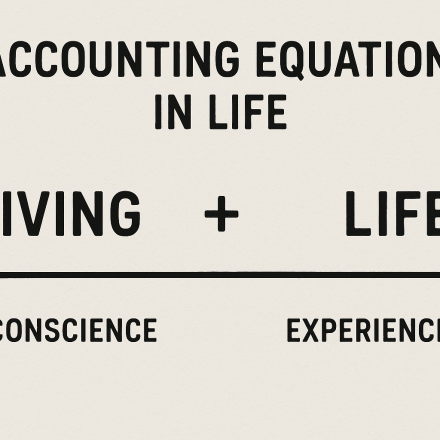
Lately, I’ve grown curious about accounting for professional reasons. My father knows the subject well, but back when he tried to teach me, I wasn’t interested—I never cared much about money matters.
Now, as I look at the simplicity of the accounting equation, I can’t help but wonder if it applies to life too. Just as assets and liabilities must balance, don’t our emotions, relationships, and choices need the same? At the end of the day, if things don’t add up—no matter how much effort we put in—we’re left with stress and imbalance.
This thought sparked a story: can the rules of accounting truly mirror the way we live our lives, or does life sometimes break the equation? However, while thinking about the great equation of account, I paused and thought whether it applies to our lives as well. So, here is a story based on my prompt and thought that can make you think about the equation as an approach to see living (not life) as well.
Once upon a time, in a quiet town nestled between green hills and a sparkling river, lived a young woman named Anika. She was a bright soul, always striving to balance her studies, work, friendships, and personal growth. Yet, lately, she felt an invisible weight pressing on her chest. No matter how much she tried, she often went to bed feeling that life was “out of balance.”
One evening, as she was scribbling in her journal, her grandfather, a retired accountant with a serene smile, noticed her frustration.
“Why the long face, Anika?” he asked, peering over her notebook.
“I try so hard in life,” she said, “to be a good friend, a diligent worker, and a healthy person, but it feels like the results never match the effort. I don’t understand why life is so… unbalanced.”
Her grandfather chuckled softly. “Maybe you need to see life the way I used to see numbers.”
He led her to an old wooden desk, where he drew a simple equation on a piece of paper:
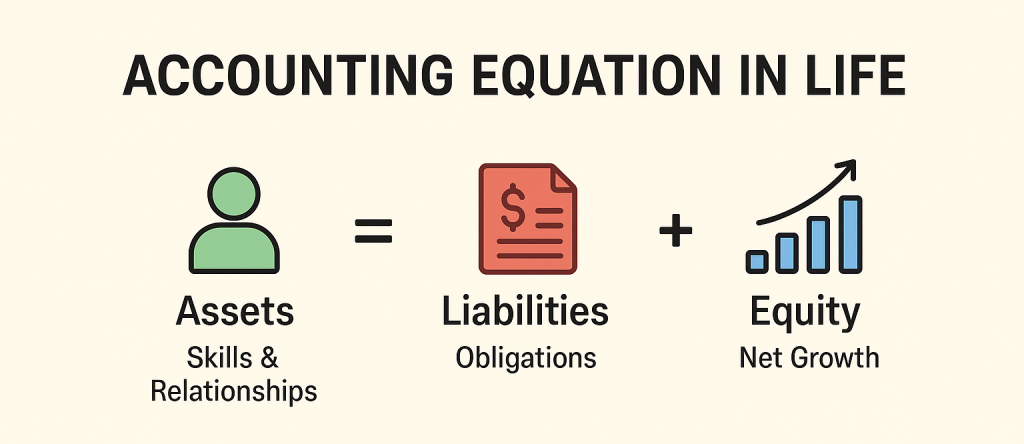
Assets = Liabilities + Equity
“Accounting,” he began, “is simple. Every asset you own—cash, property, investments—has to be balanced by liabilities and your own equity. If it’s not balanced, something’s wrong.”
Anika frowned. “But life isn’t numbers. I’m not sure this applies to me.”
Her grandfather smiled. “Let me show you.”
He drew another version, replacing the terms with parts of life:
Emotional + Mental + Physical Balance = Effort + Relationships + Self-Care
“Think of your emotional health, mental clarity, and physical wellbeing as your assets. Your effort at work, care for loved ones, and attention to yourself are like liabilities and equity—they must balance. If one side is heavier or neglected, life feels unsteady. Stress, conflict, and darkness creep in.”
Anika leaned closer. “So you’re saying I need to balance myself like I balance accounts?”
“Yes,” he nodded. “For example, if you give all your energy to work (liabilities) and neglect self-care (equity), your emotional health suffers. If you invest all your love and time in others but forget yourself, mental strain builds. The ledger of your life shows a deficit, even if everything seems outwardly fine.”
Anika sat quietly, imagining her life as a ledger: mornings filled with worry, afternoons consumed by tasks, evenings exhausted and lonely. She realized the imbalance.
“But grandfather,” she said, “even if I balance all this, sometimes life doesn’t give back what I invest. I try to nurture friendships, work hard, meditate, eat well… but outcomes are often disappointing. Does this equation really work?”
Her grandfather’s eyes twinkled. “Ah, that’s the mystery. Accounting is precise—life is not. In life, the ledger isn’t always in numbers. Sometimes you put in effort and get little in return, sometimes you gain more than you expect. But the principle remains: to survive and thrive, you must maintain balance within yourself. Assets and liabilities in your life may fluctuate, but internal balance prevents bankruptcy of the soul.”
He continued, “Think of it as a daily closing of your life ledger. At the end of the day, check: Did I care for my body? Did I nurture my mind? Did I honor my emotions? Did I give to others without losing myself? If yes, your life is balanced—even if results seem uneven.”
Anika smiled, a gentle weight lifting from her shoulders. She realized that the true measure of life wasn’t in external rewards or recognition—it was in the equilibrium she maintained internally and in her relationships.
From that night, she began treating her days like journal entries:
- Morning: Credit her mind and body with rest and nourishment.
- Afternoon: Debit effort into work and care for others, but not at the expense of herself.
- Evening: Review her emotional account, reflect, adjust, and reconcile.
Days passed, and slowly, life felt lighter. She still faced disappointments, but they no longer crushed her. The darkness that once seeped into her evenings faded because she learned to close her daily ledger in balance.
And sometimes, when she helped a friend, smiled at a stranger, or rested her weary body, she thought: Maybe life is not about perfect balance in outcomes, but about integrity in input.
At the end of one particularly challenging week, Anika paused and asked herself a question that would linger for years:
“If life doesn’t always reward effort equally, can the accounting equation truly apply? Or is its wisdom in reminding us that internal balance is the only ledger we can truly reconcile?”
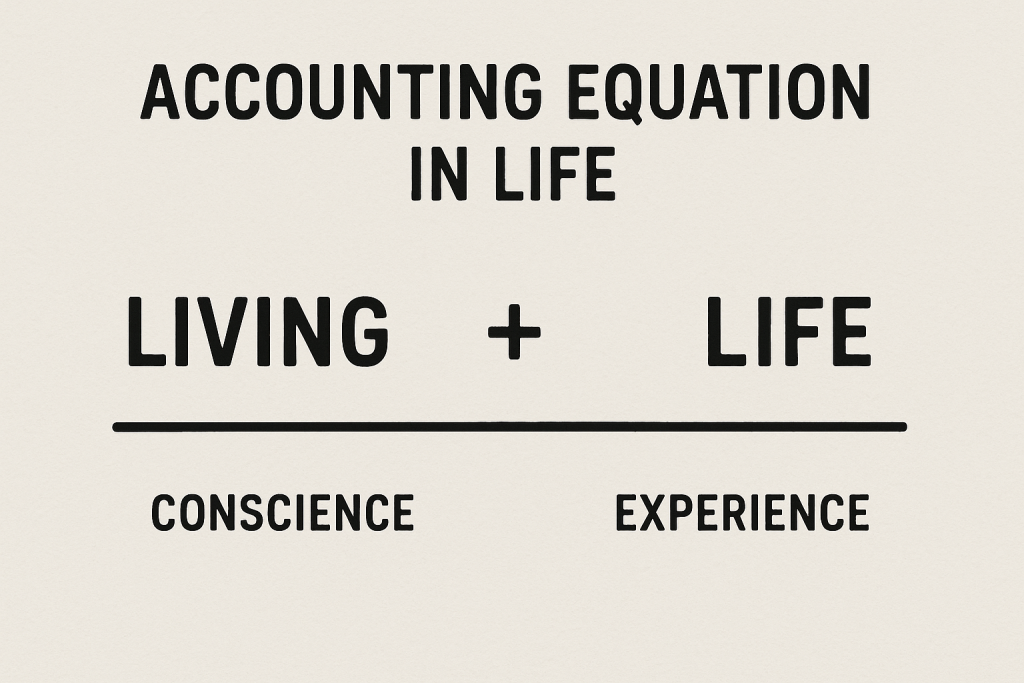
She smiled at the mystery, and for the first time, she felt rich—not in achievements, but in balance, in resilience, in the quiet harmony of her own soul. Nothing to gain and nothing to lose. There is wise saying: “Don’t keep a cat in your life.” So, zero makes the balance.


Nice breakdown, appreciate the detailed explanation here.